
There's a strange contradiction happening inside the psychedelic space right now.
On one hand, people speak openly about healing, unity, expansion, abundance, collective consciousness.
On the other, a surprising number of people still operate from fear, isolation, scarcity, and competition.
Afraid to collaborate. Afraid to share knowledge. Afraid someone else might "catch up."
And there's an even subtler version of this playing out — a kind of "holier-than-thou" energy that exists in parts of the industry. As if simply attending ceremonies for years somehow places someone beyond accountability, beyond education, or beyond the need for professional standards.
But here's the truth that doesn't get said enough:
Going through ceremonies is not the same thing as being trained to safely support other human beings.
Personal experience matters. Deeply. But personal experience alone doesn't teach you contraindications, medical screening, trauma-informed facilitation, pharmacology, ethics, integration frameworks, or how to handle a difficult and destabilizing situation when someone is in your care. It doesn't prepare you for risk mitigation, scope of practice, or how to operate responsibly in a rapidly evolving legal landscape.
And this gap, between personal experience and professional competency, is exactly why the psychedelic space needs to mature.
Not by losing its soul. Not by becoming cold or corporate.
But by becoming collaborative, ethical, educated, and grounded.
The Demand Is Real. The Opportunity Is Enormous.
More than 39 million Americans identify as psychedelic-curious. That number keeps climbing. Clinical trials are accelerating. Legal frameworks are shifting state by state. New Mexico health officials moved to launch their medical psilocybin program a full year ahead of schedule. Arizona launched its first-ever clinical trial using whole mushrooms for PTSD. The DEA proposed significant increases in psychedelic production quotas to support ongoing research.
This is not a fringe movement anymore. It is public policy, institutional momentum, and cultural conversation converging at once.
People right now are actively searching for trusted guides, integration support, preparation coaching, ethical retreats and clinics, grounded communities, and safe containers. The range of what's needed is vast, and it is far bigger than any one person, retreat, coach, or organization could ever handle alone.
So the question is worth asking honestly: why are so many people still acting like there's only enough room for them?
Scarcity Has No Place in Healing Work
Especially not work that is supposedly designed to help people become more free, more conscious, more connected, and more abundant.
Think about that for a second. If you believe in this work, if you truly believe it helps people dissolve fear, reclaim their lives, and step into greater freedom, then the way you operate in this space has to reflect that.
You can't preach abundance from a place of scarcity.
You can't teach people to open up while keeping your own doors locked.
And you especially can't hold space for others in a sustainable way if you're pouring from an empty cup yourself.
This is one of the most uncomfortable truths that doesn't get talked about enough in this space. Some people are trying to serve others while emotionally dysregulated, financially unstable, or spiritually bypassing their own unresolved work. They're surviving themselves while trying to guide others through some of the most profound experiences of their lives.
There's a reason they tell you on the airplane: put your own oxygen mask on first.
That's not selfishness. That's the prerequisite for actually helping.
What Collaboration Actually Looks Like
At Psychedelic Concierge, we've watched the opposite of gatekeeping work beautifully, and consistently.
Inside our ecosystem, people co-host retreats across different geographies and specialties. They refer clients to each other when there's a better fit. They promote one another's events, share real-world knowledge, combine modalities, and genuinely support each other's growth, professionally and personally.
Because grounded professionals understand something important: collaboration expands everyone.
And ironically, the people who are most secure in their expertise are usually the least threatened by others. They know there are countless lanes in this field. Different medicines. Different modalities. Different populations. Different callings. One practitioner may specialize in veterans. Another in executives. Another in mothers navigating identity transitions. Another in integration, or preparation, or harm reduction, or ketamine-assisted support, or retreat facilitation.
There is room for all of it. The field is that big. The need is that real.
The Future Leaders Aren't Who You Think
Here's something the industry sometimes underestimates: the people being drawn into this space right now are often incredibly sophisticated.
Many are already therapists, coaches, clinicians, wellness practitioners, founders, and facilitators. They've done real work in adjacent healing spaces. They're not looking for hype or a shortcut.
They're looking for structure. For legitimacy. For ethical standards. For a professional container where they can do meaningful work without guessing.
And the future leaders of this space won't be the loudest people on social media. They'll be the ones willing to stay humble, keep learning, collaborate openly, honor ethics even when it's inconvenient, and build sustainable practices instead of chaotic ones. The ones who operate with emotional maturity and who are genuinely willing to receive mentorship, regardless of how many years they've been in the space.
That last part matters more than people admit. We've had people with PhDs and 20 years of experience come into the Psychedelic Concierge container and discover frameworks, opportunities, and perspectives they'd never encountered before. Not because they weren't accomplished, but because isolation has limits and collaboration has none.
Structure Protects the Sacred
One more thing worth naming directly.
Professionalism is not the enemy of sacredness. Structure is not the enemy of spirituality. In many ways, structure is what protects the sacred, from exploitation, from harm, from the kind of careless or chaotic facilitation that gives this entire movement a bad name.
That's one of the core reasons Psychedelic Concierge exists. Not to gatekeep the movement. Not to create artificial hierarchy. Not to position ourselves above anyone. But to create a container, a place where people can learn responsibly, collaborate openly, build ethically, support one another, gain real-world competency, and become grounded practitioners instead of isolated enthusiasts.
Because the psychedelic renaissance does not need more lone wolves.
It needs ecosystems. It needs standards. It needs cooperation. It needs emotionally mature leaders who are more committed to the mission than to their own ego.
A Final Thought
If your true intention is to help heal the world, then another educated practitioner should not threaten you. Another ethical retreat should not threaten you. Another person stepping into their calling should not threaten you.
That should inspire you.
Because the need is far bigger than any one person. And the people who will shape the future of this movement are not the ones trying to guard the gates.
They're the ones building bridges.
Groundedly. Ethically. Collaboratively.
That's the future.
And honestly? It's already happening.
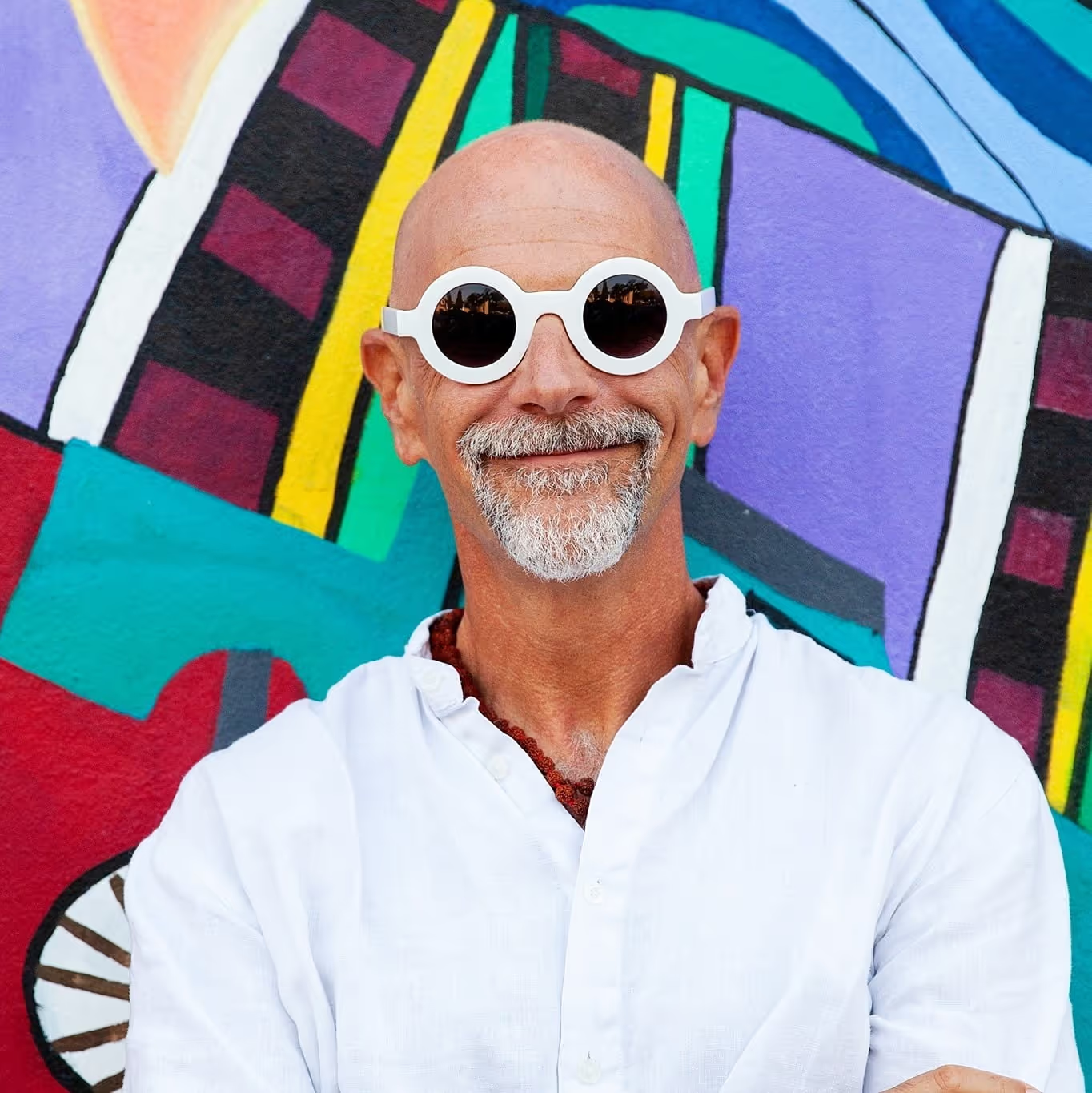
Peace and love, Sophia


.svg)