
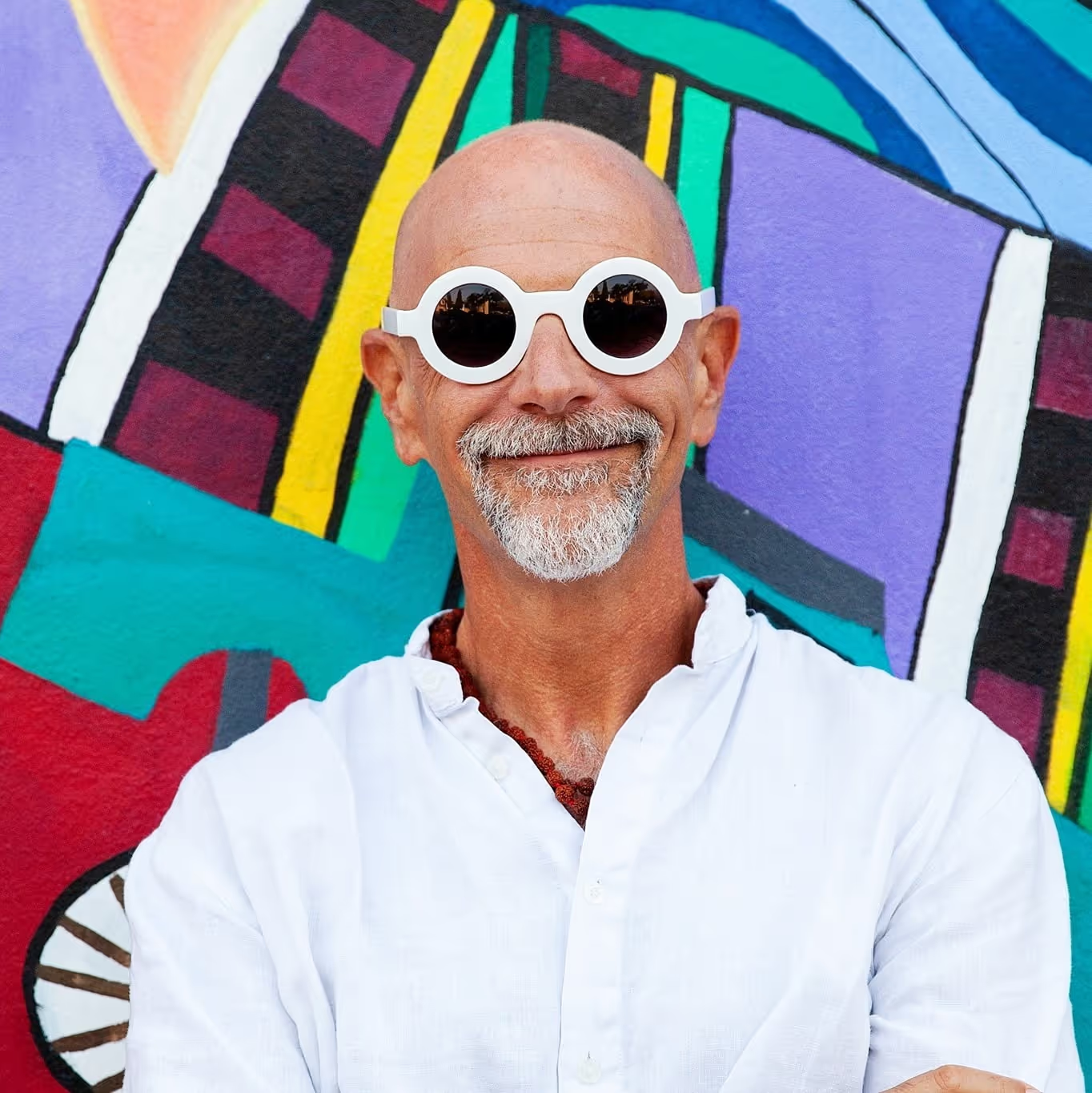
What 25 years of ceremony taught Karen Ayesh about who this work is really for, and why the West keeps getting it wrong.
There's a moment in Karen Ayesh's first ayahuasca ceremony that tells you everything you need to know about how she came to this work.
She breaks through. She finds herself standing before an enormous serpent, a being so vast she is the size of an ant next to it. And what does Karen do?
She looks up at this ancient, sovereign intelligence and says: "Nice of you to finally show up. I got this. You can step out of the way."
The snake got bigger. Karen got more audacious. She invoked free will. She demanded passage.
The medicine punched her straight in the face. In material reality, she flew three feet across the ceremony floor. She spent the next five hours on her knees, purging, in what she described as pure agony. No visions. No revelations. Just consequence.
She snuck out at 3 a.m. and swore she'd never go back.
By the following weekend, she was back. And she worked with her teacher nearly every day for the next seven years.
I keep coming back to that story, because it says something important about what's being lost right now as the psychedelic space scales fast and trains slow.
She Didn't Want Any of This
Karen grew up in the Middle East with intuitive gifts she spent most of her adult life trying to outrun. She had advanced degrees. A career in venture capital. A thoroughly academic self-concept. The gifts wouldn't stay quiet, but she kept pushing them to the back burner anyway.
A broken back redirected her to California. California redirected her to somatic therapy, naturopathy, NLP, and hypnotherapy. She studied Western psychology alongside esoteric traditions, fascinated by all of it, convinced none of it was actually her path.
Then a client mentioned a plant medicine practitioner. Then that practitioner turned out to be someone who had sat with the person who would become Karen's teacher for the next seven years. She didn't have to go to the jungle. She drove an hour.
She walked in guarded, skeptical, and deeply put off by the men in white who hugged her too long at the door. She didn't approach the medicine with reverence. She approached it like a test she expected to pass.
She didn't pass.
What happened after, the dream that confirmed her uncle's death, the second night where the medicine came back to her in sleep and essentially said "we have a contract," the carrot it dangled in front of her (knowledge, the one thing she couldn't resist), all of that moved her from "absolutely not" to "every day for seven years."
Thousands of ceremonies later, working in the Quechua, Santo Daime, and Shipibo traditions, running ceremony four or five nights a week in Southern California, Karen is one of the most grounded voices in this space. And she's clear: none of it was her idea.
The Work Chooses You. Not the Other Way Around.
This is the part that will land differently depending on where you are in your own journey.
Karen said something during her talk with our Psychedelic Concierge community that I haven't been able to shake: the people who are most eager to facilitate, who are pushing the hardest at the door, are often the ones who should wait. Because if you truly understand what it means to hold space for someone in ceremony, you don't rush toward it. The weight of it slows you down naturally.
She compared it to going to church every Sunday and deciding that qualifies you to be the pastor. The pastor goes through years of formation, supervised practice, theological training. They earn the role slowly. The congregation member may have had profound experiences in that same space. That doesn't make them the pastor.
Right now, people are spending eight weeks in the Amazon and coming home to serve medicine. That's not a niche problem. It's increasingly common, and the consequences fall on the people sitting in those containers, not the underprepared facilitator.
Karen wasn't saying this to protect territory. She said it because she has spent years putting people back together who encountered someone who wasn't ready. The casualty of insufficient training isn't the facilitator's reputation. It's the participant's stability.
"The medicine chooses you," she said. "And it's not going to come through some vision of 'yes, this is me.' You'll know because it won't let you do anything else."
Her own calling arrived through closed doors, financial pressure, a body that kept steering her toward the work until it was the only thing left available to her. Not through enthusiasm. Through necessity.
That distinction matters more than it sounds.
You Cannot Copy-Paste a Jungle Into a Clinic
The second thing Karen was direct about is something that gets glossed over constantly in the mainstream psychedelic conversation: these traditions were not built for the West, and they don't translate one-to-one.
The traditional ceremony structure evolved inside communal cultures where the work was woven into daily life. The ceremony was one component of a much larger system that included ongoing relationship, shared cultural context, long integration periods, and a facilitator who was embedded in the community they served. It was never transactional. The shaman wasn't a service provider. They were in a mutually dependent relationship with their people.
The West runs on transactions. So when these medicines arrive here, the structures that held them in place don't arrive with them.
Karen spent years working in traditional Amazon settings and then coming back to the United States and watching the gap between those two realities. Her conclusion: you have to build something that honors the essence of what these traditions are actually doing, while being honest about what's different. You can't just import the ceremony. You have to understand it deeply enough to adapt it responsibly.
She's particularly concerned about the clinical direction. When you move from ceremony to clinical protocol, from full plant medicine to isolated molecule, you progressively remove the relational and spiritual context that makes the work transformative. She described natural plant medicines as sentient intelligences, each one taking you to a specific destination, with specific requirements for entry. A synthetic compound, in her view, is a skeleton key. It gets you in the door. But without the escort, the permission, the relationship with the intelligence itself, you're entering realms without knowing what you're inviting in.
"We're taking the ceremony out of the culture," she said. "And now we're taking the molecule out of the sacrament. You think you're going to have the same results?"
Her clinical skepticism isn't anti-science. It's a recognition that the full-spectrum experience of sitting with a living plant intelligence inside a thoughtfully held container is not the same as receiving an adjusted dose of a synthesized compound in a reclining chair, however well-intentioned the clinician.
No One Person Can Hold All of This
The third thing Karen was clear about is that this work was never meant to rest on a single set of shoulders.
In traditional settings, the facilitator was embedded in community. They had support structures, cultural accountability, other practitioners around them. The idea of one person serving as ceremony holder, therapist, integration coach, and community anchor would have been unrecognizable. Roles existed because roles mattered.
That structure is exactly what responsible Western practice has to rebuild. Karen works closely with therapists, deliberately and consistently. Not because she lacks the training to do therapeutic work herself, she has studied Western psychology, NLP, somatic therapy, and hypnotherapy. She works with therapists because the moment you add entheogens to a relationship, the intimacy that opens up is real but not the same as a long therapeutic bond. People project. Transference happens. The facilitator who tries to also be the therapist creates a power dynamic that isn't safe for anyone.
"There's an enmeshment that happens in the ceremony space," she said. "I can't be everything to everybody. And if you see somebody trying to do that, you have to wonder why."
Her model is flow leadership. Different people hold different roles. The facilitator holds the ceremony container, keeps people safe inside it, moves through dark places and comes back out. The therapist holds the integration work, challenges what surfaces, provides a stable external perspective when everything feels unstable internally. The community holds the belonging, the continuity, the reminder that this isn't a solitary journey.
All three of those things are required. Not optional. Required.
The question she left the room with is the right one: what is your role in this ecosystem? Not everyone is called to hold ceremony. Many people in this space will serve as guides, integration coaches, connectors, advocates, educators. The container needs all of those roles. The mistake is assuming that sitting with the medicine is the highest contribution. Sometimes the highest contribution is being the person who helps someone integrate what they received from someone else's ceremony.
Knowing your lane isn't a limitation. It's what makes the whole system work.
The Through Line
What I keep coming back to, reading through Karen's story, is that the very thing she resisted most became the thing she was most built for. The snake didn't move because it wasn't supposed to. The door that kept closing until plant medicine was the only path left was, in retrospect, an opening she hadn't been able to see yet.
The psychedelic space is standing at a similar kind of forced reckoning right now. The door to mainstream legitimacy is open. The question is what walks through it, and whether the people walking through understand what they're actually carrying.
Karen does. Twenty-five years in, thousands of ceremonies deep, running ceremony most nights of the week, she'll still tell you she didn't choose this. It chose her. And she takes that seriously every single time.
That seriousness is what we're trying to build more of. If you're curious about what professional preparation in this space actually looks like, the Guide Briefing is a good place to start: https://go.psychedelicconcierge.com/start
Peace and love, Sophia



.svg)